
Earth Orbit Study Underway

January 29, 2026: Over the past year, when not in use, the CCERA dish has been parked pointing in a direction corresponding to the meridian crossing of the radio star J0332+5434. This star is the brightest pulsar in the northern hemisphere. It also happens to lie in the galactic plane. The dish’s data acquisition system has been programmed to wake up take data once each day when J0332+5434 passes through the dish’s beam.

In addition to observing signals from the pulsar (we will have more on that in a future post), we have been observing the Doppler shift of one of the 21-cm peaks from the galactic hydrogen. As shown in the graph below, the Doppler shift changes throughout the year as a result of the Earth’s orbital motion about the Sun. We are developing an analysis that uses this information to determine the parameters of the Earth’s orbit. We anticipate being able to determine both the semi-major axis and the eccentricity of the orbit with good accuracy. Results will be available in the coming months.
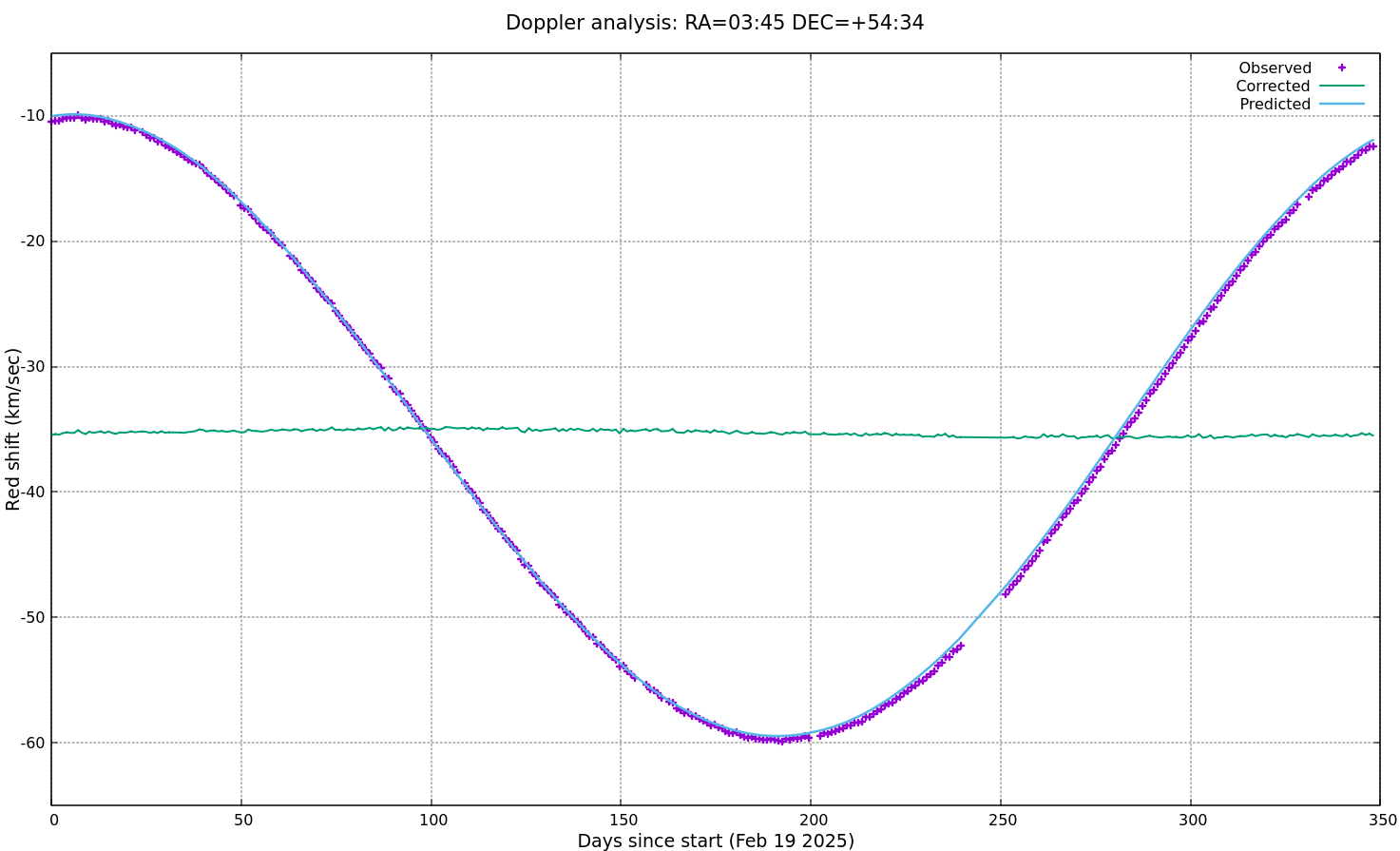
The graph above shows the Doppler shift of the 21 cm radiation from the same spot in the galaxy as a function of the number of days since Feb. 19 of 2025. The roughly sinusoidal nature of the curve reflects the Earth’s approximately circular orbit around the Sun.
2024 Open House a Roaring Success

CCERA once again hosted an Open House, as part of Doors Open Ottawa, which is an annual event across the city to encourage organizations and businesses to share their work and vision with the public.

We had over 600 visitors over the course of the two-day event, held June 1 and 2nd, and were able to do some demonstrations of dish motion this year, much to the delight of visitors.

We had a fairly-full “crew” supporting this event, with Marcus Leech, Dan Marlow, Gary Atkins, and Doug Yuill answering a nearly-continuous stream of excellent questions from visitors along with showing them around the facility.

Looking forward to next year!

-Marcus

CCERA restores motion control to the 12.8m dish

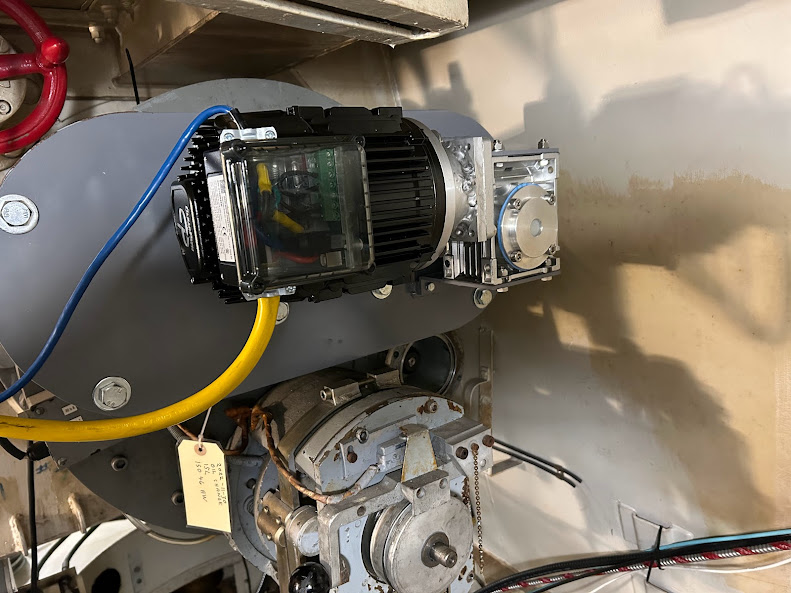
Since moving operations to the former-NATO site in Carp, in February 2022, CCERA have been exceedingly busy restoring functionality to the 12.8m dish. With generous support from Princeton University, we have been able to install a completely-modern servo-motor system from TekNic, Inc.. Initial software has been installed and tested, and we have been able to point-to, and track, astronomical objects with the dish, with a precision better than 0.06 degrees.

These motors, along with additional “prefix” gearboxes allow us to move the dish under computer control with high precision. The new motors consume a very-small fraction of the power of the original motor systems.

The precision achieved means that we can be confident in observations at 21cm, and will soon have an S-band feed system in place to allow tracking the Moon, allowing reception of lunar science mission data on missions that use S-band for the earth-directed down-link.

CCERA website damaged

Some time in the 2nd week of July, our WordPress website became damaged, by mechanisms still under investigation.

You’ll be getting “404: Not Found” for almost everything from our homepage. We’re working to get functionality restored and appreciate your patience.

-Marcus Leech

President, Canadian Centre for Experimental Radio Astronomy

CCERA Negotiates Access to former-NATO Satellite Ground Station

In the winter of 2022, we were contacted by the current owners of a former NATO satellite ground terminal. The facility includes a 14m satellite dish, capable of motion in both azimith and elevation.

We have already begun the work to restore some functionality to this instrument, including changing the feed structures to include a 21cm, 10.7cm, and 611MHz feed. We have a small photo-album here:

https://photos.app.goo.gl/1X39osyCfF4tBTrC8

Our near-term science goals include monitoring for a potential Black Hole merger in SDSS J1430+2303 along with FRB monitoring of the region around J1935+2154 and looking for super-giant pulses from the Crab Pulsar at J0534+2200.

On May 20, 2022, we were able to complete work to re-motorize (using new motor and controller) the elevation axis and were able to drive it under motor power up to an elevation of +20 DEG (-24 DEG in declination).

Look for more announcements as progress is made!

CCERA leaves Smiths Falls, moves to Rideau Ferry, ON

Owing to an unfortunate confluence of both corporate and municipal politics here in Smiths Falls, we were asked to vacate the premises we have occupied at the Gallipeau Centre since 2016.

We secured an access arrangement to a site near Rideau Ferry, ON that houses a private optical observatory, and 38 acres of flat, clear land.

The new site is much more “primitive”, and many of our activities have had to be scaled-back and/or moved to our respective private residences.

Work to restore our science capabilities is on-going, and expect further announcements as the spring and summer of 2021 progress.

Memo: 12 A pulsar observing capability at CCERA

This recent memorandum at http://www.ccera.ca/files/memos/ccera-memo-0012.pdf describes the equipment and techniques used to engage in routine monitoring of bright pulsars, in particular, J0332+5434. Our equipment choices have been largely dictated by our observing goals—we wish to observe J0332+5434 on a daily basis to provide data to a local university for their undergraduate-level course in astrophysics. The target pulsar is “bright” at lower frequencies, which means that an antenna with quite-modest gain is required to observe it. All of the radio astronomy signal processing at CCERA is based on the Gnu Radio 5 software DSP platform. The pulsar signal-processing chain is no different.

CCERA acquires surplus satellite antenna for Deuterium survey

In support of our Deuterium survey project CCERA has acquired a surplus 5.5M dish antenna that was formerly deployed at the Smiths Falls Gateway of the Globalstar network. Thanks to the careful and precise work of the expert salvage technicians at Falls Iron and Metal we were able to acquire just the critical reflector surface, without the exceedingly-heavy and expensive equipment hub and mounting hardware, which made the whole assembly weight roughly 1800Kg–much to heavy and cumbersome for CCERA to manage. The surface is made in 12 equal segments that bolt together, and combined weigh in at less than 400kg–this will make it vastly easier to handle, and to create a mounting arrangement for it.

An external photo-album shows the various pieces, and the final disposition of the reflector segments at the CCERA lab site.

Look for updates in the coming weeks as we assemble the reflector, and design and build a mount that will have it pointing full-time at the North Celestial Pole in support of our Deuterium survey.

1 2 3 6